
Industrial washing machines are not simply “bigger home washers.” They are engineered systems built for continuous-duty cycles, structural stress resistance, and thermal precision. Their architecture is closer to light industrial machinery than household appliances.
To understand their components properly, we must first understand the process logic behind their operation. Every part exists to support one of four engineering objectives: load movement, water control, energy transfer, and structural stabilization.
For a broader overview of machine types, capacities, and applications, see our Industrial Washing Machine Guide.
Table of Contents
How Industrial Washing Machines Actually Work
An industrial washer operates through controlled mechanical force and fluid dynamics. The cleaning action is created by the interaction between textile mass, water volume, detergent chemistry, and rotational energy.
The cycle follows a predictable but highly optimized sequence: controlled filling, dynamic agitation, programmed drainage, and centrifugal extraction. Each stage depends on coordinated subsystem behavior rather than isolated components.
Unlike residential machines, industrial units must maintain torque stability under extreme wet-load conditions. A fully saturated 60kg textile load can exceed 100kg in effective rotational mass, requiring reinforced structural and drive components.
System Architecture Overview
From an engineering perspective, industrial washers consist of four interconnected systems:
- Mechanical Drive System
- Water & Thermal Management System
- Structural & Vibration Control System
- Electrical & Control Intelligence System
These systems operate simultaneously, and a weakness in one will cascade into performance loss in the others.
Mechanical Drive System
The Force Behind Textile Movement
The mechanical system generates the motion necessary to dislodge soil and remove moisture. Cleaning effectiveness is not just about detergent—it is about mechanical action under controlled speed and torque.
Drum (Wash Cylinder)
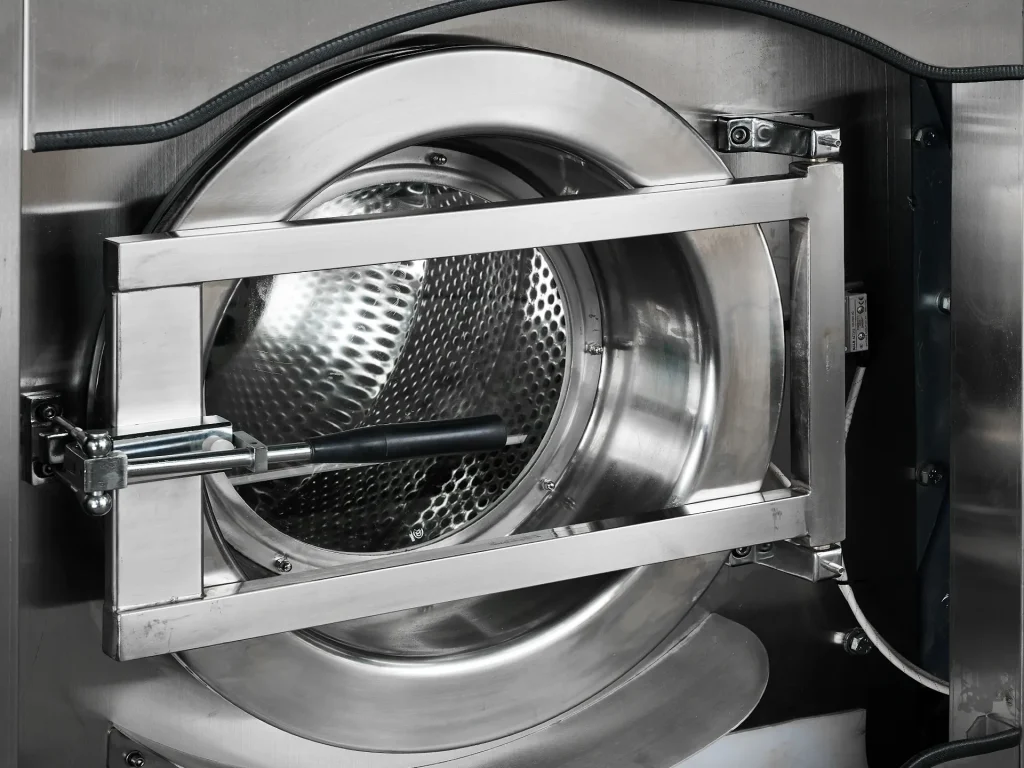
The drum is the primary containment chamber for textiles in industrial washing machine parts. It is typically constructed from high-grade stainless steel to resist corrosion, chemical exposure, and constant mechanical friction.
Industrial drums are larger in diameter and thicker in material compared to residential equivalents. Their perforation design is calculated to optimize both water exchange during wash cycles and moisture evacuation during extraction.
During agitation, the drum rotates alternately to redistribute textile mass. During extraction, it accelerates to high RPM levels, creating centrifugal force that expels water through perforations.
Drum Engineering Comparison
| Feature | Standard Commercial Washer | Barrier Washer System |
|---|---|---|
| Loading Access | Single-Side | Dual-Side (Hygiene Separation) |
| Primary Use | Hotels / Laundromats | Hospitals / Cleanrooms |
| Contamination Control | Moderate | High-Level Isolation |
| Structural Reinforcement | Heavy-Duty | Extra Reinforced |
Barrier systems are engineered for infection-control environments where cross-contamination must be eliminated.
Motor
The motor converts electrical energy into rotational force. In industrial washing machine parts systems, torque output is significantly higher because wet textiles create resistance during acceleration.
There are two dominant motor configurations. Direct-drive motors connect directly to the drum shaft, minimizing mechanical loss. Belt-driven induction motors rely on pulley systems but are easier to service in some operational settings.
Motor durability determines long-term reliability. Overheating, imbalance, and excessive load stress are primary failure triggers.
Transmission System
The transmission system converts raw motor rotation into controlled drum movement. In belt-driven machines, power is transferred via belts and pulleys that regulate speed ratios.
Direct-drive systems eliminate transmission belts, reducing friction and maintenance points. However, both systems require precise alignment to avoid vibration amplification.
The transmission must support bidirectional rotation during wash phases and stable acceleration during extraction cycles.
Bearings and Shaft Assembly
Bearings allow the drum to rotate with minimal friction under high load. They are constantly exposed to vibration, heat, and moisture, making them one of the most stress-tested components.
Industrial bearings are sealed and reinforced to withstand sustained high-speed extraction. Failure often manifests as grinding noise, vibration spikes, or unstable spin behavior.
Because the drum assembly depends entirely on bearing integrity, their condition directly influences machine lifespan.
Water and Thermal Management System
Precision Fluid Control Under Load
Water is not simply “added” during a wash cycle. In industrial systems, water volume, temperature, and flow rate are precisely regulated to balance cleaning efficiency with resource consumption.
Because industrial washing machine parts often operate continuously, inefficient water handling directly increases operating cost and mechanical stress. The hydraulic system must therefore be both durable and tightly controlled.
Inlet Valve and Flow Regulation
The inlet valve governs the volume and speed at which water enters the machine. In modern systems, this is controlled electronically through solenoid mechanisms linked to level sensors.
Accurate filling is critical. Underfilling reduces wash performance by limiting textile movement, while overfilling increases energy usage and dilutes detergent chemistry. Industrial machines therefore rely on programmable water levels based on load size and textile type.
Advanced systems incorporate flow meters to ensure repeatable precision across cycles.
Heating System and Thermal Control
Temperature plays a decisive role in soil breakdown and sanitation. In hospitality environments, moderate heat improves cleaning efficiency. In healthcare or food processing settings, high-temperature cycles are mandatory for sterilization.
Industrial washing machine parts use either electric heating elements or steam injection systems. Steam systems are common in large facilities where centralized boilers supply thermal energy more efficiently.
Temperature stability is critical. Fluctuation during wash phases reduces chemical effectiveness and compromises sanitation standards.
Thermal Configuration Comparison
| Heating Type | Energy Source | Efficiency | Typical Application |
|---|---|---|---|
| Electric Element | Internal Power | Moderate | Small Commercial Units |
| Steam Injection | External Boiler | High | Hospitals / Large Plants |
| Hybrid System | Electric + Steam | Optimized | Industrial Laundries |
Steam systems typically reduce cycle time because water heats more rapidly and maintains stable thermal conditions.
Water Pump and Drainage System
The drainage system removes contaminated water at controlled intervals. Industrial pumps must evacuate large volumes quickly to maintain cycle efficiency.
Pump capacity directly impacts throughput. Slow drainage extends cycle time, reducing daily processing capacity in commercial settings.
Clogging is one of the most common service issues. Lint accumulation, textile debris, or detergent buildup can obstruct pump flow, increasing strain and eventually leading to failure.
Drain Valve Mechanics
The drain valve works in coordination with the pump to release wastewater. It must seal completely during wash cycles and open rapidly during discharge phases.
Improper sealing results in water leakage or unstable water levels. In high-speed operations, even small drainage inconsistencies can disrupt balance during extraction.
Because drainage occurs multiple times per cycle, valve durability is essential for long-term performance.
Structural and Vibration Control System
Managing Centrifugal Force
During extraction, industrial washing machine parts generate substantial centrifugal force. A high-capacity machine spinning at full speed can produce mechanical stress that would damage a poorly reinforced structure.
Structural integrity is therefore engineered into both the internal frame and the external housing.
Suspension System
The suspension system stabilizes the drum assembly during high-speed rotation. It typically includes heavy-duty springs and industrial-grade shock absorbers mounted within a reinforced frame.
Its purpose is not just noise reduction. Suspension absorbs imbalance forces that would otherwise transfer to bearings, shafts, and mounting points.
If suspension components degrade, vibration increases, accelerating wear in other subsystems.
Frame and Structural Reinforcement
industrial washing machine parts are built with thicker steel frames compared to residential machines. Reinforced chassis structures distribute rotational force evenly across the base.
In continuous-use environments, structural fatigue becomes a long-term risk. Machines that are not properly leveled experience uneven stress distribution, shortening operational life.
Proper installation is therefore as important as mechanical quality.
Seals and Gaskets
Water containment depends on high-quality seals placed around doors, drum shafts, and drainage interfaces. These seals must tolerate heat, chemical exposure, and repeated pressure variation.
Seal degradation leads to leakage, corrosion, and electrical risk. In industrial environments, even minor leaks can escalate quickly due to constant operation.
Routine inspection prevents secondary damage that is often far more expensive than seal replacement.
Vibration Physics in Industrial Washers
When wet textiles cluster unevenly inside the drum, mass distribution becomes asymmetrical. During high-speed rotation, this imbalance creates oscillating forces.
Modern industrial washing machine parts use imbalance detection sensors. If instability exceeds safe thresholds, the machine automatically reduces speed or redistributes the load.
This safety logic protects both internal components and facility infrastructure.
Electrical and Control Intelligence System
The Digital Core of Industrial Washing Machines
Modern industrial washing parts machines rely on integrated electronic control systems that coordinate mechanical movement, water flow, temperature stability, and safety protection.
Unlike residential appliances that follow fixed timers, industrial systems use programmable logic to adapt cycle variables based on textile type, load weight, and operational standards. This precision directly affects resource efficiency and long-term mechanical stability.
Microprocessor-Based Control Panels
Most commercial-grade machines use microprocessor control boards that manage multi-stage wash curves. These systems allow operators to program variable-speed rotation, phased water intake, controlled heating intervals, and extraction acceleration ramps.
Acceleration ramp control is particularly important. Sudden torque spikes during spin-up create stress on bearings and suspension systems. Gradual ramp programming reduces mechanical shock and extends equipment lifespan.
Advanced panels also include cycle logging and error diagnostics, allowing facility managers to monitor usage patterns and identify early-stage component fatigue.
Sensors and Operational Monitoring
Industrial washing machine parts typically integrate multiple real-time sensors:
- Water level sensors to prevent overflow or underfilling
- Temperature sensors to maintain sanitization thresholds
- RPM sensors to regulate extraction speed
- Imbalance detection sensors to protect structural integrity
These sensors operate within a feedback loop. If abnormal vibration or overload is detected, the control board automatically adjusts drum speed or pauses the cycle to prevent damage.
This closed-loop system transforms the machine from a passive device into an adaptive mechanical platform.
Failure Modes in Industrial Washing Machine Parts
Stress Accumulation and Mechanical Fatigue
Industrial washing machine parts rarely fail suddenly without warning. Most breakdowns are the result of accumulated stress cycles across thousands of operating hours.
A commercial washer in a busy facility may run 6–12 cycles per day. Over five years, this can exceed 10,000 high-speed extraction events. Each extraction generates centrifugal force that gradually fatigues bearings, suspension mounts, and frame welds.
Understanding failure as a cumulative process allows operators to predict and prevent downtime.
High-Stress Components and Their Limits
The most mechanically stressed components include:
- Bearings exposed to rotational load and moisture
- Suspension assemblies absorbing repeated imbalance forces
- Drain pumps handling lint-heavy wastewater
- Motor windings subjected to thermal cycling
Industrial machines are typically rated for specific load capacities (e.g., 20kg, 40kg, 80kg). Consistent overloading, even by 10–15%, significantly accelerates component wear.
Mechanical fatigue follows an exponential pattern. Early neglect may seem harmless, but long-term effects compound rapidly.
Failure Progression Model
| Stage | Mechanical Condition | Observable Symptom | Risk Level |
|---|---|---|---|
| Early Wear | Minor friction increase | Slight vibration | Low |
| Progressive Stress | Bearing degradation | Noise during spin | Moderate |
| Structural Strain | Suspension fatigue | Excessive movement | High |
| Critical Failure | Component breakdown | Drum instability | Severe |
Detecting issues in the early stage prevents cascading damage to surrounding systems.
Preventive Maintenance Engineering
Maintenance Based on Operating Hours
Industrial equipment should not rely solely on calendar-based maintenance. Instead, service intervals should be calculated based on operating hours and cycle counts.
For example, bearings may require inspection after 3,000–5,000 high-speed cycles depending on load class. Drain pumps in lint-heavy environments may need quarterly inspection regardless of apparent performance.
Lubrication, vibration analysis, and load balancing checks significantly reduce unexpected shutdowns.
Lifecycle Cost and Efficiency Modeling
Initial purchase price represents only a fraction of total ownership cost. Energy consumption, water usage, maintenance downtime, and replacement industrial washing machine parts contribute to long-term expense.
Machines equipped with variable-frequency drives (VFD) and direct-drive motors often reduce energy loss during acceleration and deceleration phases. Over a 10-year operational period, efficiency differences can translate into substantial cost savings.
When selecting equipment, evaluation should include:
- Rated extraction G-force
- Energy consumption per cycle
- Water usage per kilogram of textile
- Expected service interval
A machine optimized for operational efficiency often outperforms lower-cost alternatives over its lifespan.
If you’re comparing manufacturers and reliability across the market, review our breakdown of leading brands.
Top 6 brands of industrial washing machines
FAQ of Industrial washing machine parts
How long do industrial washing machines last?
With proper maintenance of industrial washing machine parts, 10–15 years is typical in commercial environments.
What is the most common part failure?
Bearings and water pumps experience the most industrial washing machine parts wear due to constant load and moisture exposure.
Are industrial washers energy efficient?
Modern direct-drive systems with programmable controls significantly reduce energy and water consumption.
What causes excessive vibration?
Common causes include unbalanced loads, worn suspension components, or bearing failure.
Can Industrial washing machine parts be replaced individually?
Yes. Most components such as motors, pumps, and valves are modular and replaceable.
 Spanish
  English