
Table of Contents
To the casual observer, the process of cleaning clothes seems mundane—a simple matter of soap, water, and agitation. However, when the scale shifts from a single household to a regional healthcare system or a 5,000-room resort, the physics changes entirely.
Understanding how industrial laundry works in 2026 requires looking past the “washing machine” concept and viewing the facility as a high-speed chemical and thermal processing plant. In these environments, success is measured not just by the absence of stains, but by the precision of the throughput, the conservation of resources, and the absolute elimination of pathogens.
The journey of a soiled linen through a modern plant is a masterpiece of industrial engineering. It is a process that integrates robotics, thermodynamics, and real-time data analytics. For those new to the sector, exploring what is industrial laundry is the first step in realizing that this is an infrastructure-heavy industry where equipment uptime and utility efficiency dictate profitability. Unlike domestic washing, which is a “batch” process, industrial laundry is a “flow” process, where thousands of pounds of textiles move through a synchronized assembly line every hour.
The Intake Phase: Sorting and Soil Classification
The first stage in understanding how industrial laundry works begins at the loading dock. Sorting is arguably the most labor-intensive and critical phase of the entire operation. In a high-volume plant, textiles arrive in massive “slings” or carts, often weighing hundreds of pounds. Before a single drop of water is used, these items must be classified by fabric type, soil level, and color. Mixing a heavy-duty polyester chef’s coat with a delicate high-thread-count cotton sheet is a recipe for mechanical and chemical failure.
Modern facilities in 2026 utilize overhead rail systems—often referred to as “Sling Systems”—that use gravity and automated tracks to move laundry through the ceiling space, saving valuable floor real estate. Many of these items are embedded with RFID (Radio Frequency Identification) tags.
As the bags pass through scanners, the system automatically knows exactly what is inside, how many times it has been washed, and which customer it belongs to. This level of data integration is a core component of the comprehensive industrial laundry guide 2026, which notes that automated sorting can reduce labor costs by up to 30% while preventing the “redeposition” of dirt that occurs when disparate soil types are washed together.
The Wash Core: Inside the Tunnel Washer
If the sorting area is the brain of the facility, the “Tunnel Washer” (or Continuous Batch Washer) is the heart. To truly grasp how industrial laundry works, one must visualize a massive, horizontal steel cylinder, often forty to sixty feet long, divided into multiple internal chambers. Unlike a home washer that fills and drains for every cycle, a tunnel washer is a “counter-current” system.
In a tunnel washer, the linen moves in one direction while the water flows in the opposite direction. The cleanest water enters at the end of the tunnel for the final rinse and then migrates toward the beginning of the tunnel to be used for the initial pre-wash.
This “recycled” water carries the residual heat and chemicals from the clean end to the dirty end, drastically reducing energy and detergent consumption. Each chamber in the tunnel serves a specific purpose: the first few for “wetting out” and soil release, the middle for the “main wash” at high temperatures, and the final chambers for rinsing and “souring” (neutralizing the pH). This continuous flow allows a 12-module tunnel to process over 2,000 pounds of laundry per hour, a feat explored in depth within our guide to industrial services and systems.
The Extraction Phase: Membrane Presses and Centrifuges
Once the linen emerges from the final rinse chamber of the tunnel washer, it is soaking wet and incredibly heavy. The next step in how industrial laundry works is not drying, but “Mechanical Extraction.”
In a residential setting, this is done by spinning the drum at high speeds. In an industrial plant, particularly those using tunnel washers, we use a “Membrane Press” (or Water Extraction Press).
The linen “cake” is pushed into a massive hydraulic press where a heavy-duty rubber membrane, backed by up to 40-50 bars of pressure, squeezes the water out of the fabric. This process is far more efficient than spinning. It reduces the residual moisture content to approximately 45-50%, which is the ideal state for the subsequent drying or ironing phases.
By removing water mechanically rather than thermally, the facility avoids the massive energy expenditure required to turn liquid water into steam in a dryer. This efficiency is a primary driver in the ROI of industrial laundry operations, as every drop of water squeezed out by the press is a drop that doesn’t need to be evaporated using expensive natural gas.
The Thermal Phase: Drying and Conditioning
Once the membrane press has completed its cycle, the laundry is no longer a loose collection of items but a compressed, dense “cake.” Understanding how industrial laundry works at this stage involves “Conditioning.”
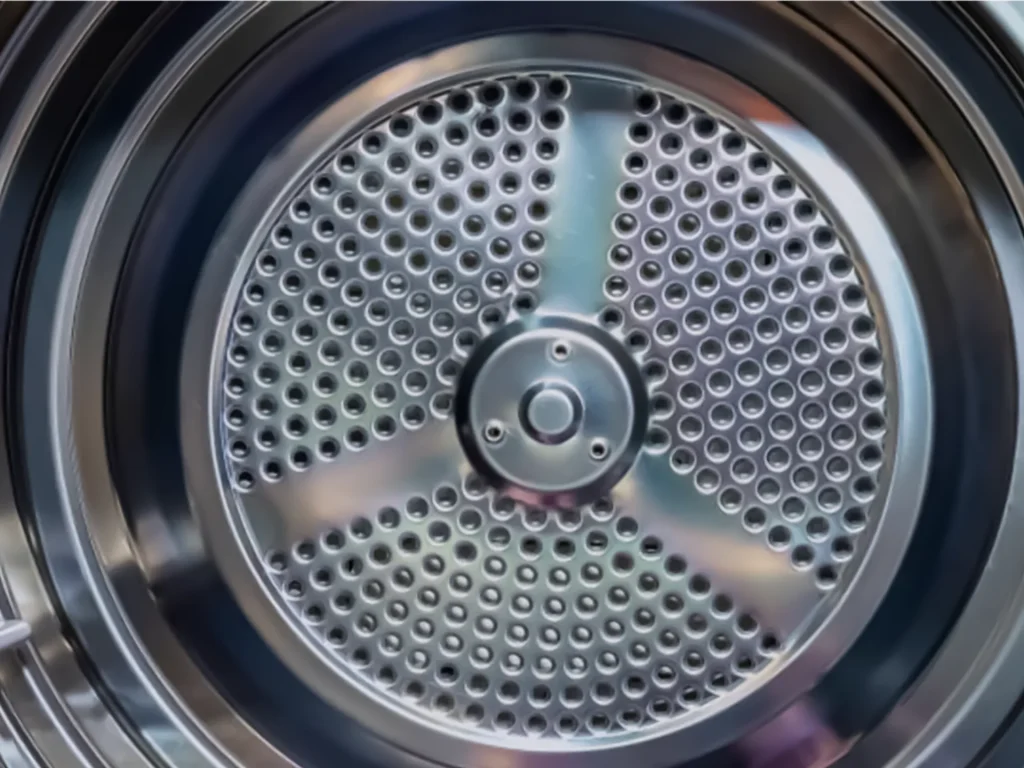
These cakes are automatically transferred via conveyor or overhead sling into massive tilting dryers, often called “Pass-Through Tumblers.” Unlike a home dryer that rotates in one direction, industrial tumblers use a bi-directional “shuttling” action to break the cake apart, ensuring that hot air can penetrate every fiber.
In 2026, the drying process is governed by infrared “In-Basket” sensors. These sensors do not just measure the air temperature; they measure the actual surface temperature of the textiles. When the fabric reaches its critical moisture point—usually around 5% to 8% for items going to the ironer—the burner shuts off, and a “cool-down” phase begins.
This precision prevents “fiber fry,” a condition where over-drying makes cotton brittle and prone to tearing. By avoiding even two minutes of unnecessary heat, a large-scale plant can save thousands of dollars in monthly natural gas costs, a recurring theme in the Industrial Laundry Costs: Complete Breakdown, Cost per Pound & ROI Calculation Guide 2026.
The Finishing Line: Ironing and Flatwork Processing
For bedsheets, pillowcases, and tablecloths, the journey from the dryer is not the end. To achieve the “Five-Star” crispness required by luxury hospitality, these items move to the finishing line. This is perhaps the most visually impressive part of how industrial laundry works.
The process begins with “Automated Feeders.” Operators or robotic arms snap the corners of a damp sheet into high-speed clamps, which then use a vacuum-assisted “Spreader” to pull the fabric perfectly flat before it enters the ironer.
The ironer itself consists of multiple massive, steam-heated polished steel cylinders, sometimes up to 48 inches in diameter. As the sheet passes between the heated roll and a pressurized padded chest, the residual moisture is instantly turned into steam, and the fibers are permanently flattened. Modern “Multi-Roll” ironers can process linens at speeds of up to 50 meters per minute.
This high-speed finishing is not just about aesthetics; the 160°C heat provides a final stage of thermal disinfection, ensuring that the Industrial Laundry Applications: The Core of Commercial Cleaning & Hygiene 2026 standards are met before the linen is ever touched by a folding machine.
Automated Folding: The Geometry of Efficiency
The final mechanical hurdle in how industrial laundry works is the transition from a flat, hot sheet to a perfectly stacked bundle. This is handled by “Primary Folders” and “Cross-Folders.” As the ironed linen exits the rollers, a series of light-curtain sensors measure the length of the item. Using a combination of precisely timed air blasts and mechanical blades, the machine executes the first two longitudinal folds.
The item then moves to the cross-folder, which performs the final lateral folds. Advanced machines in 2026 are equipped with “Edge Detection” AI, allowing them to detect if a sheet is torn or stained during the folding process.
If a defect is found, the machine automatically rejects the item into a separate bin for re-washing or repair. This automated quality control is a critical component of the Industrial Laundry Services: The 2026 Strategy Guide for On-Premise vs. Outsourcing, as it allows the facility to guarantee a 99.9% “Grade-A” output to their clients without the need for hundreds of manual inspectors.
Chemical and Biological Validation
While the mechanical flow is the “body” of the process, the chemistry is the “blood.” To truly understand how industrial laundry works, one must look at the titration reports. Every hour, a technician or an automated sensor kit tests the water in the tunnel washer to ensure the “Chemical Balance” is perfect.
- Alkalinity Check: Ensuring the pH is high enough (usually 11-12) to swell the fibers and release lipids.
- Bleach Concentration: Verifying that the oxidation levels are sufficient to kill 99.999% of pathogens (Log-5 reduction).
- Neutralization (Sour): Confirming that the final rinse brings the fabric back to a skin-safe pH of 6.0.
- Water Hardness: Monitoring the ion exchange to prevent mineral buildup that can gray the linens.
This constant validation ensures that the facility is not just “washing” but is performing a controlled chemical reaction. For healthcare providers, this data is often uploaded to a cloud dashboard, providing a digital audit trail that proves every single towel and gown has been processed according to medical safety standards.
The Logistics of Clean: Packing and Dispatch
The final stage in understanding how industrial laundry works involves the critical transition from “processed textile” to “shippable inventory.” In a professional facility, this occurs in the “Clean Zone”—a strictly controlled environment pressurized with filtered air to prevent lint and dust from the “Soiled Zone” from re-contaminating the finished goods. Once the automated folders have stacked the linens, they are moved via conveyor to a “Banding” or “Shrink-Wrap” station.
In 2026, many high-volume plants use compostable bio-plastics to wrap linen bundles, protecting them during transit while maintaining the facility’s sustainability goals. Each bundle is then labeled with a barcode or RFID-scanned to update the client’s digital inventory in real-time.
This ensures that a hotel manager knows exactly how many clean “Par 1” sets are currently on the delivery truck before it even reaches the loading dock. This logistical precision is a cornerstone of the What is Industrial Laundry? 2026 Guide to Services, Systems & Costs, as it effectively bridges the gap between a manufacturing process and a high-level service industry.
Efficiency Metrics: Throughput and Utility Ratios
To truly master how industrial laundry works, a facility manager must look beyond the machines and analyze the “Utility-to-Linen Ratio.” In a world of rising energy costs, a plant’s profitability is determined by how little water and gas it can use to process one pound of fabric.
- Water Efficiency: A “Green” facility aims for less than 0.8 gallons of water per pound. Traditional plants using older washer-extractors might use 2.5 gallons. This 3x difference in water consumption often dictates the entire Cost per Pound & ROI Calculation for a large-scale project.
- Pounds per Operator Hour (PPOH): This is the ultimate labor metric. In a manual laundry, PPOH might be 40-50 lbs. In a fully automated plant using tunnel washers and high-speed feeders, PPOH can exceed 150 lbs.
- Thermal Efficiency: This measures the amount of natural gas (BTUs) required to evaporate one pound of water in the dryer or ironer. Modern heat-reclamation systems can recapture up to 40% of this energy, feeding it back into the incoming cold water supply.
By monitoring these KPIs through a centralized SCADA (Supervisory Control and Data Acquisition) system, the plant manager can identify “Bottlenecks” in real-time. For instance, if the tunnel washer is producing linen faster than the ironers can process it, the system will automatically adjust the tunnel’s “Transfer Time” to prevent a pile-up on the clean-side conveyors.
Conclusion: The Future of Autonomous Textile Care

Understanding how industrial laundry works in 2026 is an exercise in appreciating the union of mechanical force and digital intelligence. The industry has moved from “labor-intensive” to “data-intensive.” As we look toward the next decade, we are seeing the rise of fully autonomous plants where robotic arms handle the soiled sorting and AI-driven cameras perform 100% of the quality inspections.
For the businesses that rely on these “Heroes of Cleanliness,” the industrial laundry process is the invisible engine of their own success. Whether it is a sterile surgical drape or a fresh hotel towel, every piece of fabric tells a story of high-pressure extraction, precision chemistry, and thermal excellence. By investing in these sophisticated workflows, facilities ensure that the standard of “clean” continues to evolve alongside the demands of the modern world.
FAQs: How Industrial Laundry Works
How is “Medical Grade” cleanliness achieved?
It is achieved through a combination of “Thermal Disinfection” (holding the wash at 71°C for over 25 minutes) and “Chemical Oxidation.” Industrial laundries also use “Barrier Washers” to ensure that soiled air never mixes with clean air, a process explained in detail in our comprehensive industrial laundry encyclopedia.
Why do industrial machines use steam instead of electric heaters?
Steam is a far more efficient carrier of energy for large-scale heating. An industrial boiler can heat thousands of gallons of water and power multiple ironers and dryers simultaneously using a fraction of the electricity that would be required for resistive heating elements.
How does a tunnel washer keep different customers’ laundry separate?
The tunnel washer uses “Batch Integrity.” Each chamber (or module) contains a specific weight of linen (e.g., 110 lbs) that moves as a single unit. The PLC software tracks each “slug” of linen as it moves through the tunnel, ensuring that Customer A’s sheets never mix with Customer B’s towels, even though they are in the same machine at the same time.
What happens to the lint in an industrial plant?
Because industrial dryers process so much fabric, they generate massive amounts of lint. Automated “Lint Collectors” or “Scrubbers” use water or high-pressure air to capture this debris before it can exit the exhaust stack. This prevents fire hazards and keeps the surrounding environment clean.
Does the high-pressure press damage the buttons on shirts?
Generally, “Flatwork” (sheets and towels) is processed through membrane presses because it has no buttons. For garments like shirts and lab coats, the facility uses specialized “Centrifugal Extractors” or high-G spin cycles to remove water without the crushing force of a hydraulic press.
 English
  Spanish