
Table of Contents
The decision between managing textiles internally with domestic equipment or utilizing high-capacity infrastructure is a pivotal moment for any growing business. In the debate of industrial laundry vs home laundry, the choice often seems simple at first glance—residential machines are cheaper and familiar. However, as an organization scales, the hidden inefficiencies of domestic washing begin to erode profit margins and compromise service quality. In 2026, where utility costs and labor expenses are at historic highs, understanding the mechanical and economic divide between these two worlds is essential for long-term operational success.
To navigate this landscape, one must first recognize what industrial laundry is in the modern era. It is not merely “more washing machines”; it is a synchronized industrial system designed for maximum throughput, precision chemistry, and thermal efficiency. A residential washer is designed to handle the needs of a family of four, processing perhaps five loads per week. An industrial plant, by contrast, is engineered to run 24 hours a day, processing thousands of pounds of linen without interruption. When a business attempts to bridge this gap using consumer-grade equipment, they often find themselves trapped in a cycle of frequent mechanical breakdowns and inconsistent hygiene results.
The Three-Tier Model: Residential vs. Commercial vs. Industrial
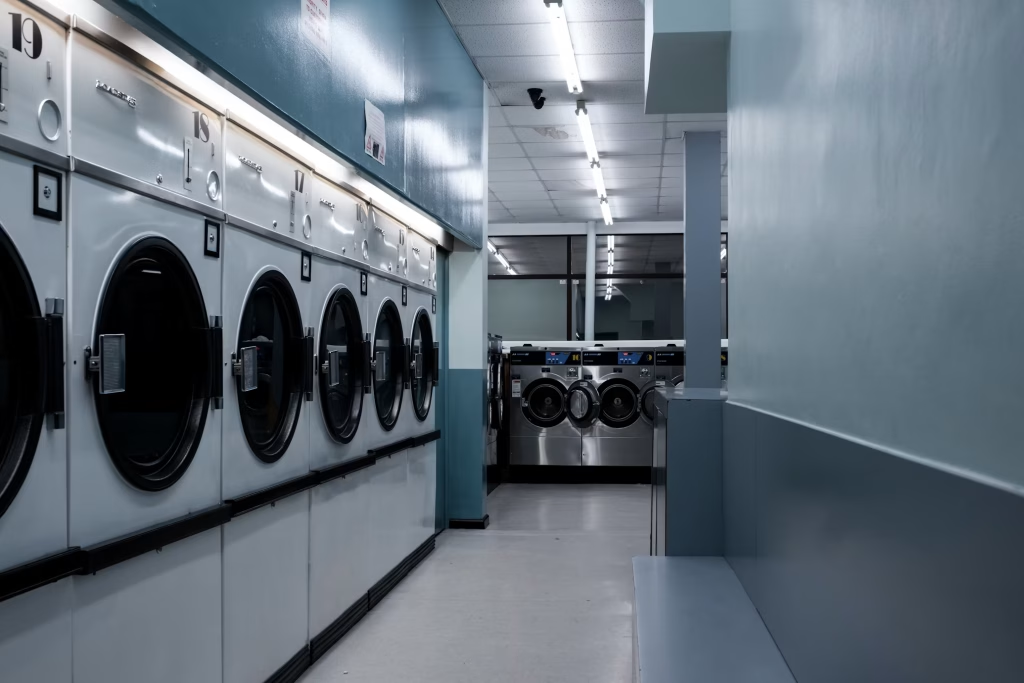
To make an informed choice, it is helpful to view laundry through a three-tier model. This allows business owners to identify exactly where they sit on the spectrum of textile care and when they need to transition to the next level of service.
Tier 1: The Residential Model
Residential laundry is built for convenience and variety. These machines are designed to handle a mixture of delicate silks, sturdy denim, and synthetic activewear in small batches. The primary focus is on fabric preservation for individual garments rather than high-speed sanitization. While modern home washers are increasingly “smart,” they lack the heavy-duty bearings and stainless steel outer drums required for continuous operation. For a small bed-and-breakfast with only two rooms, this model may suffice, but even at this small scale, the cost per pound of laundry is significantly higher than in a professional setting due to inefficient water and electricity usage.
Tier 2: The Commercial Model
Often confused with industrial systems, the commercial model occupies the middle ground. These are the machines you find in laundromats or small apartment complexes. They are built more robustly than home washers and often feature coin or card-op systems. While they can handle higher volumes than a domestic unit, they still operate on a “batch” principle and lack the sophisticated chemical dosing and steam-injection capabilities of true industrial hardware. For many growing businesses, this is a temporary stepping stone, but it often lacks the comprehensive industrial laundry strategy required to manage healthcare or high-end hospitality requirements.
Tier 3: The Industrial Model
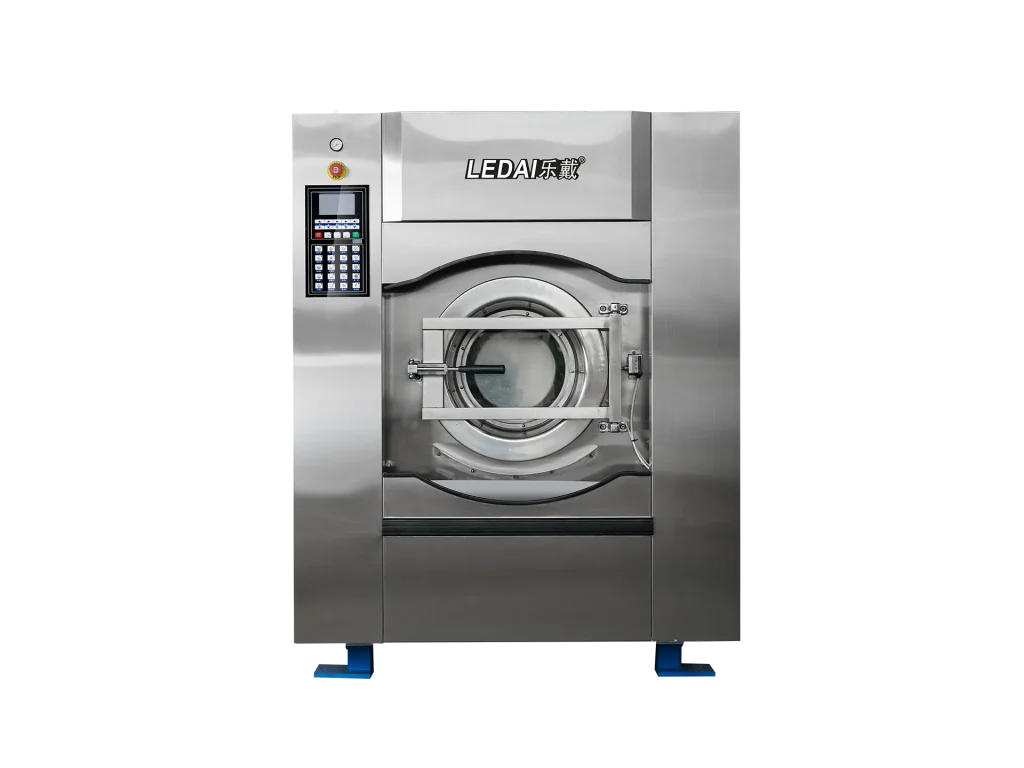
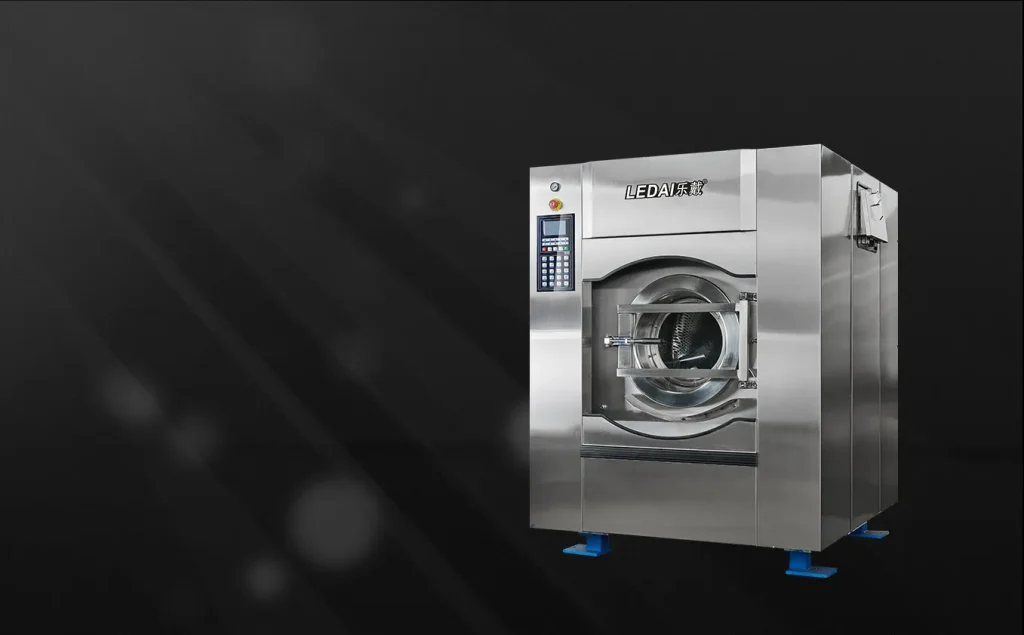
The industrial tier represents the pinnacle of textile engineering. These facilities utilize tunnel washers (continuous batch washers) and massive washer-extractors that can hold up to 500 pounds of linen in a single drum. Everything in an industrial plant is optimized for the “Life-Cycle” of the textile. From the way water is recycled to the precise milligram of detergent injected, industrial systems are designed to provide the lowest possible cost per piece while ensuring medical-grade disinfection. This is the realm where businesses transition from “doing laundry” to “managing a textile supply chain.”
Mechanical Differences: Engineering for Durability
When comparing industrial laundry vs home laundry, the most immediate difference is the sheer mechanical force involved. A residential washer uses a small motor and a belt-drive system that is prone to slipping or snapping under heavy loads. Industrial machines, however, utilize direct-drive motors and oversized industrial bearings that can withstand the immense G-forces required to extract water from heavy towels and bedsheets.
During the final spin cycle, an industrial extractor can reach forces exceeding 350G. This extreme pressure is not just for show; it is a critical economic driver. By removing more water during the mechanical extraction phase, the facility drastically reduces the energy required in the drying phase. In a residential setting, clothes often emerge from the washer quite damp, requiring a 60-minute cycle in an inefficient electric dryer. In an industrial facility, the same items would be dried in half the time using high-efficiency gas tumblers or passed directly through a flatwork ironer. This mechanical efficiency is a core reason why professional facilities can maintain such a low industrial laundry cost breakdown compared to in-house domestic operations.
Furthermore, industrial machines are built for “Serviceability.” In a home washer, if a bearing fails, the machine is often deemed “totaled” because the labor to repair it exceeds the cost of a new unit. Industrial hardware is designed with modular components that can be replaced in minutes, ensuring that the facility experiences minimal downtime. This industrial-grade resilience is a recurring theme in the comprehensive encyclopedia of commercial laundry 2026, which emphasizes that the longevity of the machine is as important as the quality of the wash.
The Chemistry of Scale: Detergents and pH Management
When evaluating industrial laundry vs home laundry, the conversation often ignores the liquid science happening inside the drum. In a residential setting, “all-in-one” detergents are the standard. these products are designed to be safe for a wide variety of colors and fabrics, which inherently means they are not optimized for any specific heavy-duty soil. They rely on mild surfactants and pleasant fragrances to give the illusion of cleanliness.
Industrial laundry systems, however, utilize a multi-stage chemical injection process. Instead of a single soap, an industrial washer-extractor typically uses five to seven different chemicals per load:
- Alkaline Builder: To swell the fibers and release deeply embedded dirt.
- Surfactant/Detergent: To suspend the dirt in the water so it can be rinsed away.
- Bleach/Sanitizer: Chlorine or oxygen-based agents for high-level disinfection.
- Sour (Neutralizer): To bring the fabric back to a skin-safe pH level.
- Softener/Bacteriostat: To provide a premium feel and inhibit future bacterial growth.
This precision is managed by automated dosing pumps, ensuring that every milligram of chemical is used effectively. In a home laundry environment, users often “over-pour” detergent, leading to chemical buildup that actually attracts more dirt over time. In an industrial plant, the chemistry is adjusted based on the water hardness and the specific soil type, ensuring a level of professional industrial laundry service that a domestic machine simply cannot replicate.
Cost Analysis: The “Price per Load” Myth
Many business owners stick with home-style washers because they see a low “sticker price” at the appliance store. However, the true cost of laundry is found in the operational cycle. To illustrate the economic divide in industrial laundry vs home laundry, consider the following comparison based on 2026 utility and labor rates.
Operational Cost Comparison Table (Per 100 lbs of Linen)
| Cost Factor | Home Laundry (Multiple Units) | Commercial/Laundromat | Industrial Plant (Tunnel/Large Extractor) |
| Water Consumption | 250–300 Gallons | 150–200 Gallons | 50–80 Gallons (with recycling) |
| Energy (Dry/Wash) | High (Electric focus) | Moderate | Low (Steam/Gas optimization) |
| Labor Time | 4–6 Hours (Manual loading) | 2–3 Hours | < 45 Minutes (Automated) |
| Chemical Cost | $8.00 – $12.00 (Retail) | $5.00 – $7.00 | $2.50 – $4.00 (Bulk) |
| Textile Lifespan | Lower (Chemical buildup) | Moderate | Highest (pH balanced) |
As shown in the table, the industrial laundry vs home laundry debate is heavily weighted toward industrial scale once you move beyond basic domestic volumes. While a home washer might cost $800 and an industrial extractor costs $15,000, the industrial unit’s ability to process 10x the volume in 1/4 of the time means that the “break-even” point is reached much faster than most owners anticipate. For a more granular financial breakdown, the Industrial Laundry Costs: Complete Breakdown, Cost per Pound & ROI Calculation Guide 2026 provides a spreadsheet-style model for calculating your specific facility’s potential savings.
Hygiene Standards and Regulatory Compliance
In 2026, the definition of “clean” has been codified by strict health regulations, particularly for the hospitality and healthcare sectors. This is perhaps the most dangerous area for businesses that rely on home laundry. A residential washer typically tops out at a water temperature of 40°C to 50°C (105°F to 120°F). While this is fine for removing a coffee stain, it is insufficient for “Thermal Disinfection.”
Thermal vs. Aesthetic Cleaning
Industrial systems are designed to reach and maintain temperatures above 71°C (160°F) for at least 25 minutes, a standard required by the CDC and international health boards to kill pathogens like MRSA, C. diff, and various viral strains. In the context of industrial laundry vs home laundry, a home machine provides “Aesthetic Cleaning”—the item looks and smells good, but it is not necessarily “Hygienically Clean.”
Furthermore, industrial facilities often employ a “Barrier” design. This architectural choice physically separates the soiled laundry receiving area from the clean finishing area using a wall. The washing machines are loaded on the “dirty” side and unloaded on the “clean” side. In a home or small commercial laundry room, clean linens often sit in the same space where soiled bags are opened, leading to significant risk of cross-contamination. For facilities prioritizing safety, the What is Industrial Laundry? 2026 Guide to Services, Systems & Costs details these barrier requirements in full.
Operational Workflow: Speed and Throughput
The most valuable commodity in any business is time. In a home laundry setup, the “Cycle Time” is the bottleneck. A typical high-efficiency home washer takes 50 to 70 minutes to complete a cycle, followed by 60 minutes in the dryer. This means a single 20 lb load takes roughly two hours to move from dirty to dry.
An industrial facility operates on a “Continuous Flow” principle. If a hotel uses a tunnel washer, a new 100 lb “slug” of laundry enters the machine every 3 minutes. By the time the first load is finishing its final rinse, twenty more loads are already in the pipeline. This level of throughput is what allows a resort to turn over 500 rooms in a single afternoon. When comparing industrial laundry vs home laundry, the home model is a “Stop-and-Go” process, while the industrial model is a “Constant Stream.” This difference in momentum is a key factor explored in the comprehensive strategy guide for on-premise vs outsourcing, which helps owners decide if they have the volume to justify a “Constant Stream” infrastructure.
Sustainability: The Environmental Impact of Each Model
As we move through 2026, environmental compliance has become a significant factor in the industrial laundry vs home laundry debate. On the surface, a single home washer seems to consume very little. However, when you multiply that consumption by the dozens of machines required to match the output of one industrial unit, the ecological footprint becomes staggering. Industrial facilities are designed as “closed-loop” ecosystems. Through the use of ceramic filtration and ozone disinfection, a modern plant can recycle up to 70% of its water.
In contrast, a residential washer is a “linear” consumer; it pulls fresh water from the municipal line, heats it with inefficient internal elements, and flushes it directly into the sewer after a single use. The thermal energy used to heat that water is lost forever. Industrial plants utilize “Heat Exchangers” to capture the warmth from wastewater to pre-heat the incoming fresh supply. For any business aiming for “Green Certification” or looking to reduce their carbon footprint, the comprehensive encyclopedia of commercial laundry 2026 highlights that industrial-scale efficiency is the only viable path to true sustainability.
The Decision Matrix: When to Make the Switch?
Deciding when to transition from a domestic or small-scale setup to a full-scale industrial operation is a matter of “Volume vs. Value.” To help business owners navigate this, we have developed a 2026 Decision Matrix based on weekly poundage and hygiene requirements.
- The “Startup” Phase (0–200 lbs/week): At this volume, high-quality residential or small commercial “stack” units are often the most practical. The capital investment for industrial gear is not yet justified, provided your industry does not require certified thermal disinfection.
- The “Growth” Phase (200–1,000 lbs/week): This is the danger zone. Most businesses try to add more home washers here, but the labor costs and maintenance downtime begin to skyrocket. This is the ideal time to look into industrial laundry vs home laundry costs and consider either a small OPL (On-Premise Laundry) with a single 50 lb extractor or a professional service contract.
- The “Scale” Phase (1,000+ lbs/week): At this level, industrial infrastructure is a mechanical necessity. The savings in water, chemicals, and labor will typically pay for the equipment within 36 to 48 months. For a deeper look at this transition, the 2026 strategy guide for on-premise vs outsourcing is a mandatory read for any facility manager at this stage.
Conclusion: Engineering Your Operational Success

The comparison of industrial laundry vs home laundry is ultimately a comparison of “Chore vs. Strategy.” While a home washer is a wonderful tool for a household, it is a liability for a professional enterprise. By investing in industrial-grade systems, you are not just buying a machine; you are buying predictability, hygiene, and a lower total cost of ownership. Whether you choose to build your own facility or partner with a specialized provider, the shift to industrial-scale thinking is the first step toward true operational excellence.
FAQs: Industrial Laundry vs Home Laundry
Is industrial laundry harsher on fabrics than home washing?
Paradoxically, no. While industrial machines use more aggressive mechanical action, they use much more precise chemistry. Home washing often leaves residual detergents in the fibers, which act like sandpaper over time. Industrial “sour” cycles neutralize these chemicals, often resulting in a longer textile lifespan.
How many home washers equal one industrial washer?
To match the daily output of a single 100 lb industrial washer-extractor, you would need approximately 10 to 12 high-end residential washers. However, the home washers would require significantly more floor space, more plumbing connections, and five times the labor to load and unload them individually.
Can I use home detergent in an industrial machine?
It is highly discouraged. Home detergents are formulated for high-water-volume “top-loaders” or “front-loaders” and create excessive suds. In an industrial machine, “suds-lock” can occur, which cushions the fabric and prevents the mechanical action needed to get it clean. Industrial chemicals are low-sudsing and high-efficiency.
What is the “Total Cost of Ownership” (TCO) difference?
The TCO of industrial laundry vs home laundry favors industrial gear over a 10-year period. A home washer has a typical lifespan of 3,000 cycles, whereas an industrial machine is built for 30,000+ cycles. You would likely replace your home washer four or five times before the industrial unit requires its first major overhaul.
Does industrial laundry save on insurance premiums?
In many cases, yes. Professional industrial layouts include advanced fire suppression in dryers and lint-collection systems that reduce the risk of fire. Businesses running multiple residential dryers often face higher premiums due to the increased risk of lint fires in consumer-grade exhaust ducts.
 English
  Spanish