
Table of Contents
Industrial washing machines vary significantly in design and application. Choosing the right industrial washing machine types is as important as calculating capacity (see: Industrial Washing Machine Capacity: Complete Calculation & Sizing Guide) and understanding how core components function (see: Industrial Washing Machine Parts and Functions). In this expanded guide, we explore the major industrial washing machine types, how they differ, and real-world use cases across industries — from hospitality to healthcare and large-scale commercial laundries.
This article also links to our brand comparison resource, which helps evaluate manufacturers across these industrial washing machine types (see: Top 6 Industrial Washing Machines Brands (Buyer’s Guide)).
1. Why industrial washing machine Types Matter
Not all industrial washers are created equal — they are engineered for specific environments, throughput requirements, and textile profiles. A mismatch between machine type and laundry workflow can lead to:
- Higher operating costs
- Reduced cleaning effectiveness
- Increased maintenance frequency
- Lower lifespan due to mechanical stress
To optimize performance and total cost of ownership, it’s essential to match machine type with operational needs.
2. Overview of Industrial Washing Machine Categories
Below is a high-level contrast of the major industrial washing machine types used in commercial and industrial laundry operations:
| Machine Type | Typical Capacity | Key Feature | Best For |
|---|---|---|---|
| Front-Load Washer | 15–60 kg | Flexible, space-efficient | Hotels, small laundries |
| Tunnel Washer | 200–600 kg/hr | Continuous processing | Large commercial plants |
| Barrier Washer | 20–100 kg | Cross-contamination control | Hospitals, labs |
| Batch Washer | 50–400 kg | Grouped batch processing | Universities, resorts |
| High-Speed Washer Extractor | 30–100 kg | High extraction efficiency | Facilities prioritizing dryer throughput |
Each machine type brings unique strengths and constraints. Below we break them down with practical use cases.
3. Front-Load Industrial Washers
What They Are
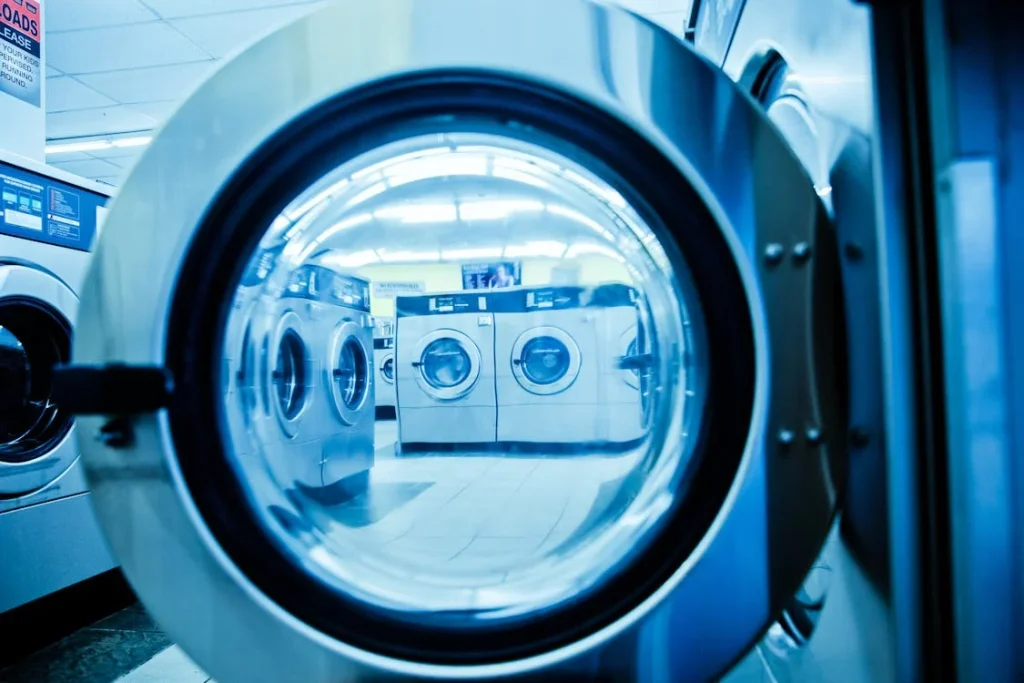
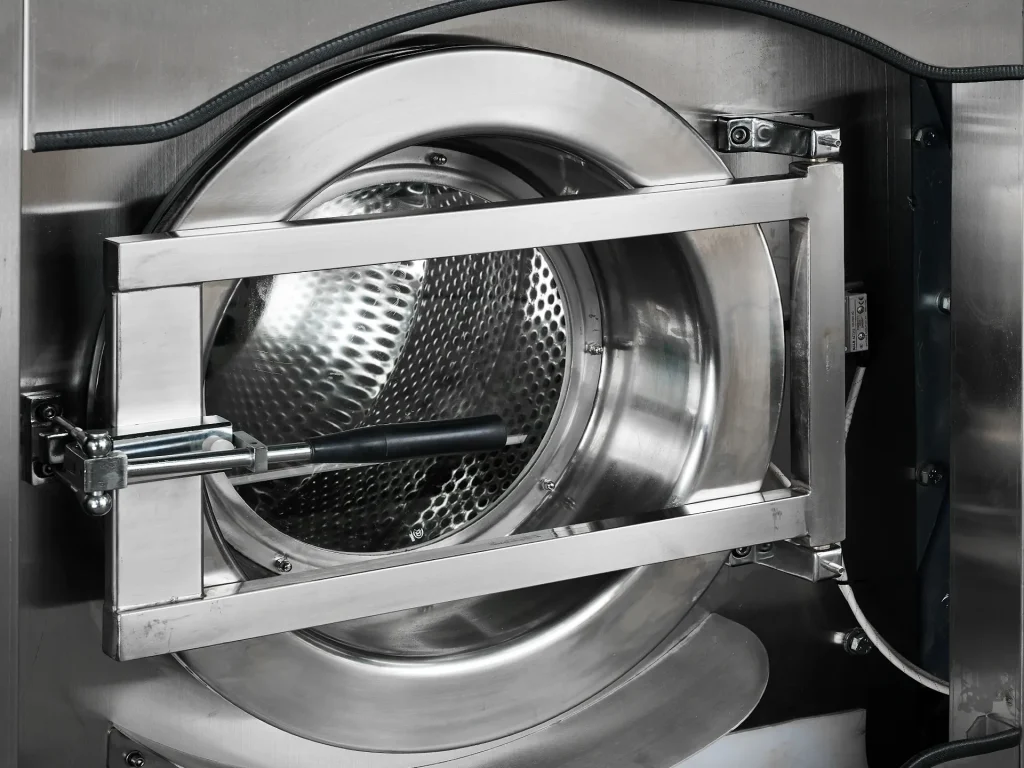
Front-load washers are the most common industrial washers. They resemble larger versions of household machines but are engineered for high frequency cycles and heavier loads.
Key Engineering Characteristics
- Robust drive systems
- Reinforced drums designed to handle wet weight stress
- Flexible programming for varied textile types
These machines often operate best with load factor ratios between 75–85% for cleaning efficiency and mechanical life, a concept explained in the capacity guide.
Use Cases
Hotel Laundries
Front-load machines are ideal for mixed loads — towels, linens, uniforms — with frequent wash cycles and moderate throughput.
Small to Medium Commercial Laundries
When daily load volume is predictable and consistent, front-load washers offer excellent balance between throughput and energy efficiency.
Variations Within Category
| Feature | Benefit |
|---|---|
| Variable Frequency Drive (VFD) | Adaptive motor control |
| High G-Force extraction | Reduces drying time |
| Multi-phase heating | Improves sanitization |
For a deeper breakdown of the part roles in these systems, see: Industrial Washing Machine Parts and Functions.
4. Tunnel Washing Systems
Technology Core
Tunnel washers represent a completely different engineering philosophy. Instead of batch cycles, they use continuous processing — textiles move through a tunnel of wash, rinse, and extraction zones.
Why It Matters
Tunnel washers dramatically increase throughput without increasing labor. Textile movement is controlled via internal paddles and water jets, resulting in uniform cleaning across massive volumes.
Use Cases
Large-Scale Industrial Laundry Plants
Any operation processing 1000+ kg per day benefits from tunnel systems.
Healthcare & Hospitality Chains
High volume consistency is critical where uniform turnover must meet strict timelines.
Capacity & Throughput
| Zone | Function | Approx. Time |
|---|---|---|
| Wash | Primary detergent action | 5–10 min |
| Rinse | Soil flush | 3–6 min |
| Extraction | Water removal | 2–4 min |
Total throughput can reach 200–600 kg per hour depending on configuration and textile type.
Because tunnel washers operate continuously, they require careful capacity planning that balances machine speed, water flow, and operational staffing.
5. Barrier Washers
What Sets Them Apart
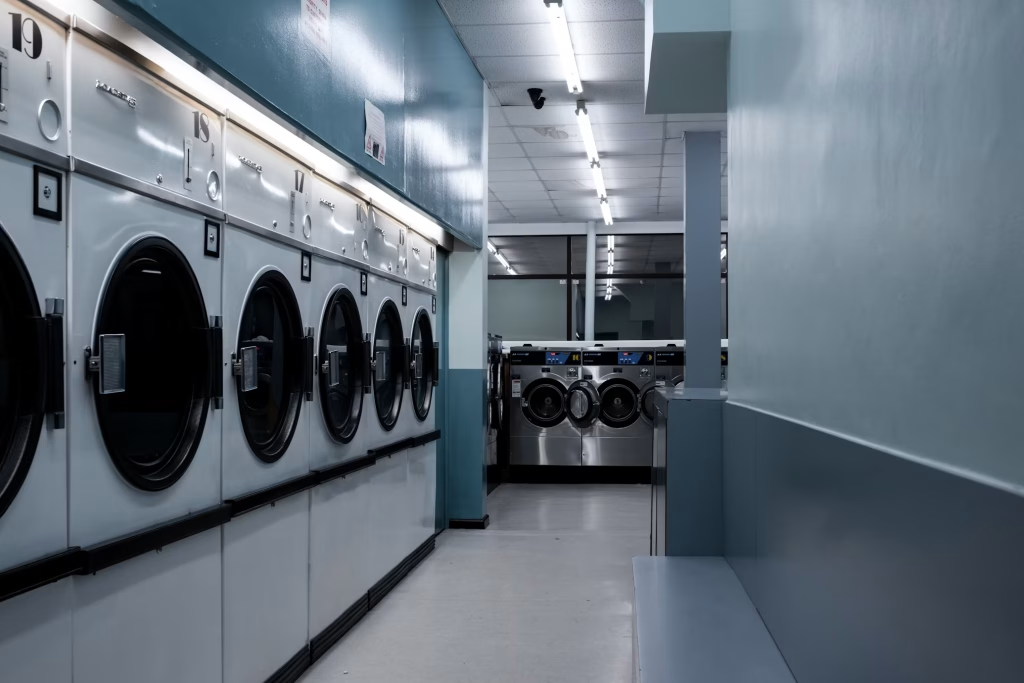
Barrier machines are engineered specifically to prevent cross-contamination. They feature two distinct chambers separated by a physical barrier — one for dirty textiles and one for clean — with strict workflow protocols.
Critical Use Cases
- Healthcare facilities
- Research laboratories
- Cleanrooms with regulatory compliance
How They Work
Personnel handle textiles on one side, and a separate team handles clean textiles on the other. Detergent dosing, water temperature, and cycle programming are synchronized to meet sanitization standards.
Barrier washers are often paired with thermal or chemical disinfection cycles, where temperature and chemical exposure variables influence material choices — another consideration discussed in our stainless steel materials article.
6. Batch Washers (Modular High-Volume Systems)
What Is a Batch Washer?
Batch washers are designed for grouped processing rather than fully continuous flow like tunnel systems. They allow operators to divide laundry into controlled segments while still achieving high daily throughput.
Unlike tunnel systems, batch washers provide more flexibility in load type variation while still supporting centralized workflow management.
Engineering Characteristics
Batch systems typically include:
- Centralized water recovery systems
- Programmable zone segmentation
- Integrated extraction units
These systems balance automation and operational flexibility, making them a middle ground between front-load washers and full tunnel installations.
Ideal Use Cases
Universities & Institutional Campuses
Laundry volume fluctuates seasonally. Batch washers allow capacity scaling without fully committing to tunnel infrastructure.
Resort Chains
Resorts often process mixed textile types (linen, spa robes, towels). Batch configuration allows grouping loads without sacrificing efficiency.
7. High-Speed Washer Extractors
What Makes Them Different?
High-speed washer extractors prioritize water removal efficiency. They operate at significantly higher G-force levels during spin cycles, which reduces moisture retention before drying.
The mechanical advantage is simple: less residual water equals shorter drying time, lower energy consumption, and increased daily throughput.
Technical Considerations
Extraction speed is directly tied to drum construction and suspension systems — concepts explained in detail in:
→ Industrial Washing Machine Parts and Functions
→ Industrial Washing Machine Capacity: Complete Calculation & Sizing Guide
Improper load sizing can overstress suspension systems and reduce lifespan.
Best Use Cases
Commercial Laundromats
High customer turnover environments benefit from reduced drying time.
Facilities With Limited Dryer Capacity
If dryer infrastructure is constrained, investing in high-speed extraction can increase total system efficiency without adding dryers.
8. Matching Machine Type to Industry Applications
Choosing the right type requires analyzing three variables:
- Daily throughput (kg/day)
- Textile type variability
- Contamination risk level
Below is a simplified industry matching matrix:
| Industry | Recommended Type | Why |
|---|---|---|
| Small Hotel | Front-Load Washer | Flexibility + cost efficiency |
| Large Hotel Chain | Tunnel or Batch | High throughput consistency |
| Hospital | Barrier Washer | Infection control |
| Commercial Laundry Plant | Tunnel Washer | Maximum automation |
| Laundromat | High-Speed Extractor | Dryer efficiency |
9. Capacity vs Machine Type Decision Framework
Many operators mistakenly focus only on drum size. However, machine type determines workflow efficiency more than raw capacity.
For example:
A 60 kg front-load washer may process fewer total kilograms per hour than a smaller tunnel zone operating continuously.
To determine optimal configuration:
- Calculate total daily volume (see: Industrial Washing Machine Capacity Guide).
- Identify peak load hours.
- Map workflow sequence from soil sorting to folding.
Then align machine type with operational bottlenecks.
10. Operational Cost Implications by Type
Machine type influences:
- Water consumption
- Energy use
- Labor requirements
- Maintenance frequency
Tunnel washers reduce labor cost but require higher upfront investment.
Front-load systems require more manual handling but are flexible and scalable.
When comparing equipment providers across these categories, consult:
→ Top 6 Industrial Washing Machines Brands (Buyer’s Guide)
Brand selection should align with the machine architecture you choose.
11. Total Cost of Ownership by Machine Type
When evaluating industrial washing machines, upfront price is only a fraction of total lifecycle cost. High-CPC queries typically revolve around cost efficiency, ROI, and operational optimization — not just features.
Total Cost of Ownership (TCO) includes:
- Equipment purchase price
- Installation cost
- Energy consumption
- Water usage
- Labor cost
- Maintenance & downtime risk
Machine type significantly impacts these variables.
Comparative Lifecycle Overview
| Machine Type | Initial Investment | Labor Cost | Energy Efficiency | Scalability | Best ROI Scenario |
|---|---|---|---|---|---|
| Front-Load | Low–Moderate | Medium | Moderate | High | Small–mid operations |
| Tunnel | High | Low | High (volume optimized) | Very High | Large centralized plants |
| Barrier | Moderate–High | Medium | Moderate | Medium | Healthcare compliance |
| Batch | High | Low–Medium | High | High | Institutional systems |
| High-Speed Extractor | Moderate | Medium | High (drying savings) | Medium | Dryer bottleneck facilities |
Tunnel systems demand capital, but for facilities exceeding 1,000 kg/day, automation often produces the strongest long-term margin.
For accurate throughput sizing before investment, refer to:
→ Industrial Washing Machine Capacity: Complete Calculation & Sizing Guide
12. Workflow Optimization: Machine Type + System Design
Industrial laundry profitability is not determined by the washer alone. It depends on how the washer integrates with:
- Sorting workflow
- Water heating systems
- Extraction phase
- Drying capacity
- Finishing equipment
For example:
A high-speed extractor reduces drying time by lowering residual moisture content, directly decreasing energy costs in gas or electric dryers.
Conversely, installing a tunnel washer without upgrading water recycling systems can increase operational cost instead of reducing it.
Understanding internal components — drum design, drive systems, extraction mechanics — is critical for integration decisions. Detailed technical breakdowns are available here:
→ Industrial Washing Machine Parts and Functions
13. Industry-Specific High-ROI Configurations
Hospitality (Mid to Large Hotels)
Most profitable configuration:
- Multiple front-load washers (30–60 kg)
- High-speed extraction capability
- Balanced dryer ratio
Why?
Hotels experience predictable daily load volume but require flexibility for mixed textile types. Front-load systems offer lower capital risk and modular scalability.
Healthcare Facilities
Most efficient configuration:
- Barrier washers
- Controlled thermal disinfection cycles
- Separated workflow design
Here, compliance and contamination control outweigh raw throughput.
Material selection (e.g., stainless steel grade durability) directly impacts maintenance frequency and lifespan.
Industrial Laundry Plants (High Volume)
Most profitable configuration:
- Tunnel washer
- Water recycling system
- Central extraction press
- Automated textile movement
At this scale, labor cost reduction and continuous throughput generate the highest ROI.
When evaluating suppliers for these setups, compare engineering standards across brands:
→ Top 6 Industrial Washing Machines Brands (Buyer’s Guide)
14. Capacity, Machine Type, and Expansion Planning
One of the most common high-cost mistakes is underestimating future expansion.
A front-load setup that meets today’s 500 kg/day demand may struggle when volume grows to 1,200 kg/day.
Machine type selection should consider:
- Future occupancy growth
- Contract expansion potential
- Energy infrastructure limits
- Space availability
Planning beyond immediate demand reduces expensive retrofitting later.
15. Decision Checklist Before Purchasing
Before selecting any industrial washing machine type, confirm:
- What is the average daily volume (kg)?
- What is the peak hourly throughput requirement?
- Are contamination protocols required?
- What is the available utility infrastructure?
- How many operators are available per shift?
Then align answers with machine architecture.
Machine type defines workflow structure, cost structure, and scalability.
Capacity defines sizing.
Brand defines engineering quality.
Each layer must align.
16. Final Thoughts: Choosing the Right Type for Long-Term Efficiency
Industrial washing machines are not interchangeable appliances. They are workflow engines.
Choosing the correct type:
- Reduces operating cost
- Increases textile lifespan
- Improves sanitation reliability
- Enables scalable growth
The optimal decision requires balancing:
Type + Capacity + Component Quality + Brand Engineering
For deeper reference materials:
- Capacity planning: Industrial Washing Machine Capacity Guide
- Technical breakdown: Industrial Washing Machine Parts and Functions
- Brand comparison: Top 6 Industrial Washing Machines Brands
When these three dimensions align, the machine becomes a strategic asset rather than a cost center.
FAQ
What are the main industrial washing machines Types?
The main industrial washing machine types include front-load washers, tunnel washers, barrier washers, batch systems, and high-speed washer extractors. Each type is designed for specific capacity levels and operational workflows.
What is the difference between tunnel washers and front-load washers?
Tunnel washers operate continuously and are designed for high-volume centralized laundry plants. Front-load washers work in batch cycles and are better suited for hotels, small commercial laundries, and flexible load management.
Which type of industrial washing machine is best for hospitals?
Barrier washers are typically preferred in healthcare facilities because they prevent cross-contamination by separating dirty and clean textile zones.
How do I choose the right industrial washing machine type?
Start by calculating your daily laundry volume, peak throughput demand, contamination requirements, and available infrastructure. Then match those needs with the appropriate machine type and capacity.
Are industrial washing machines more energy efficient than commercial models?
Industrial machines are designed for durability and high throughput. Energy efficiency depends on extraction speed, load optimization, and system integration rather than just machine category.
 English
  Spanish